
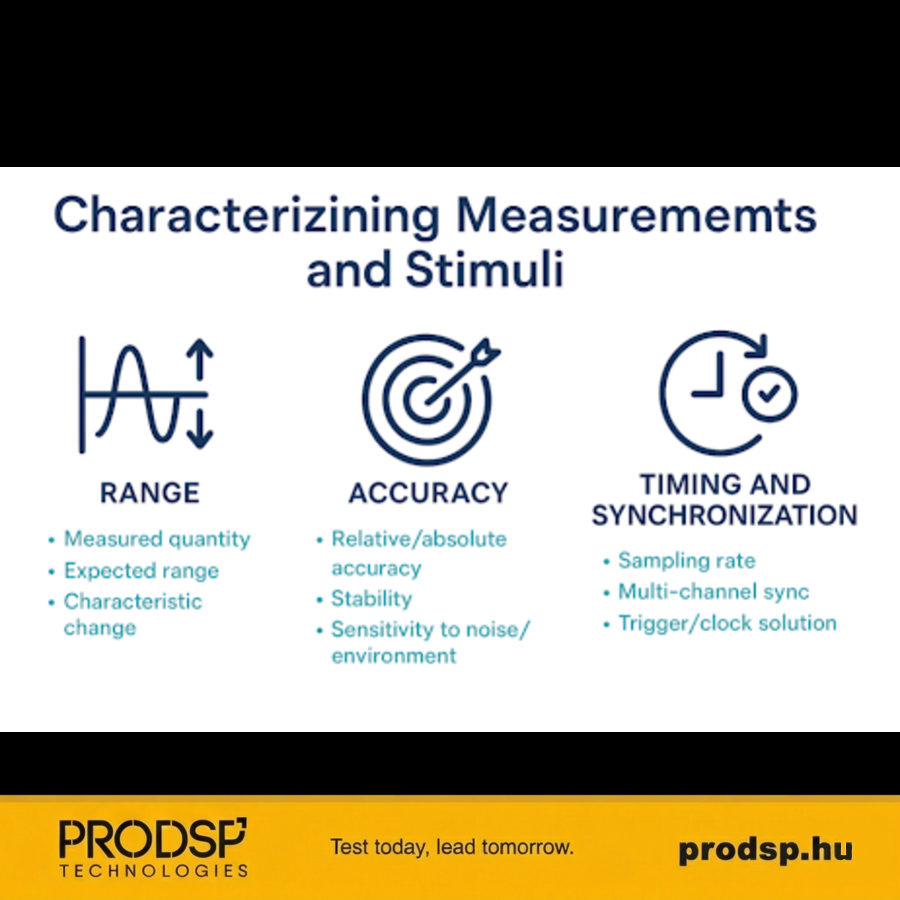
#2 - Characterizing Measurements and Stimuli
📐 Characterizing Measurements and Stimuli – Key Considerations When Designing Industrial Measurement Systems
The task of a measurement system is twofold:
1️⃣ To stimulate the Device Under Test (DUT)
2️⃣ To measure the resulting physical responses
To design an effective measurement architecture, the following considerations should be clarified in advance:
🔹 Range
– What physical quantity are we measuring?
– What is the expected signal range?
– Does the DUT's behavior change across different operating ranges?
🔹 Accuracy
– What level of relative/absolute accuracy is required?
– Is short-term or long-term measurement stability more critical?
– How sensitive is the measurement to noise and environmental factors?
🔹 Timing and Synchronization
– What sampling rate is required (samples/sec)?
– Is multi-channel, parallel, or cross-instrument synchronization needed?
– What kind of trigger and clock solution ensures simultaneous data acquisition?
These questions could influence not only the selection of appropriate instruments but the overall system architecture.